Pink Floyd: The Long Goodbye
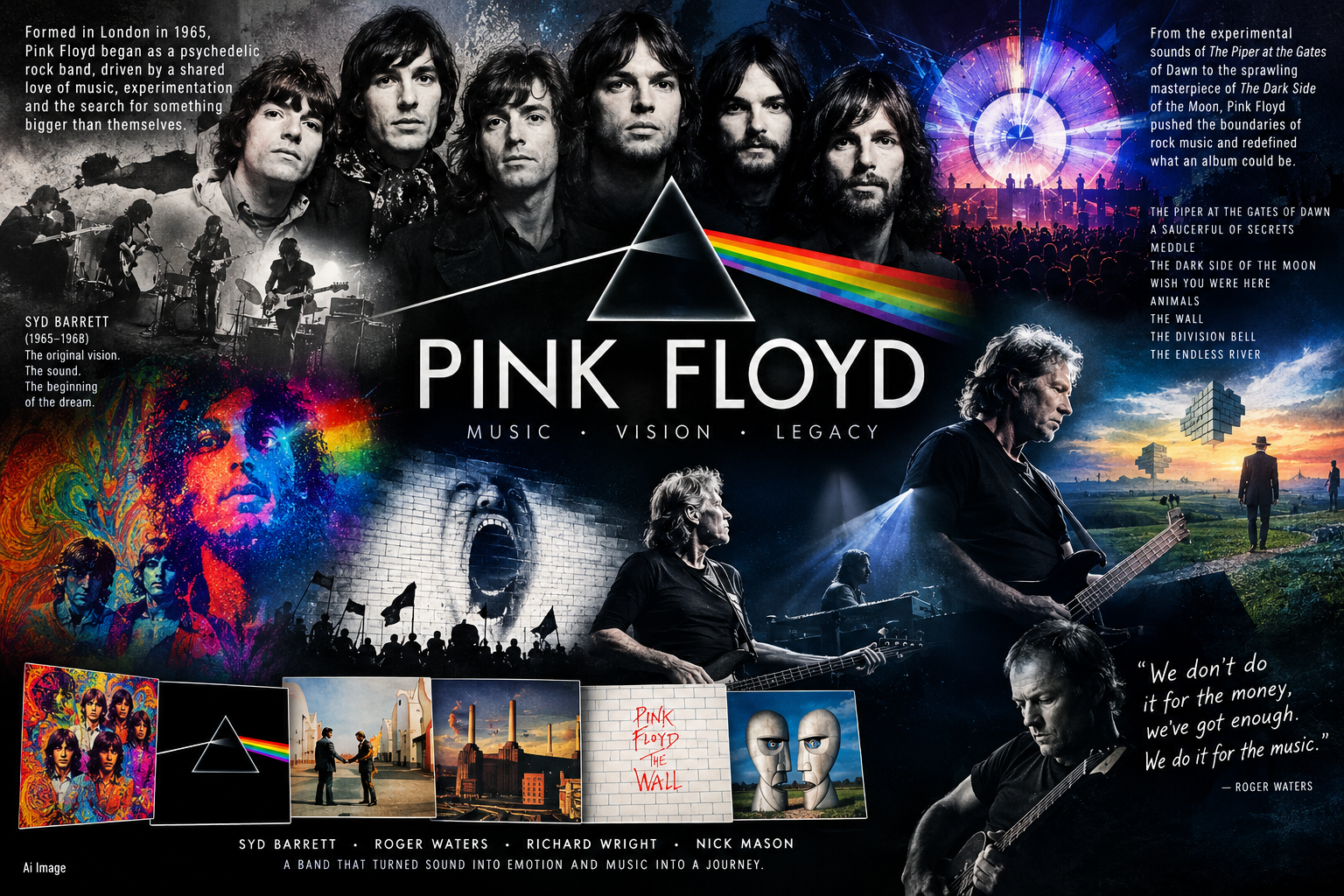
Dopamine Soul · An Eight-Part Series
Pink Floyd: The Long Goodbye
Four men, one prism, and the long conversation about being alive.
Part One
The Boys From Cambridge
They were not supposed to become a band. They were supposed to become architects. Roger Waters and Nick Mason met in September 1962 in the same lecture rooms at the Regent Street Polytechnic in London, studying how buildings stand up. Music was the thing they did after the studying stopped. A friend needed players. One thing led to another, the way it does when you are young and restless and the whole century seems to be tilting under your feet. 12931
Richard Wright, another architecture student, joined them, quieter than the others, drawn to jazz and to the strange new sounds a keyboard could make. The group changed names the way other people change clothes. The Abdabs. The Screaming Abdabs. Sigma 6. The Meggadeaths. Names that sound like private jokes, because that is exactly what they were. 1231
Then came the name that stuck. The band was calling itself the Tea Set when they discovered that another group with the same name was booked at one of their shows. Syd Barrett, the art student from Cambridge who had drifted into their orbit, reached for something else on the spot. He took the first names of two American bluesmen he loved, Pink Anderson and Floyd Council, and stitched them together. The Pink Floyd Sound. It was a private reference, a small act of devotion, and it became one of the most recognised names in music. 1226
Cambridge is where the story really begins, though. Barrett and David Gilmour grew up in the same town, close enough that they took guitar lessons from the same teacher in the early 1960s. They were not yet bandmates. That would take years, and a kind of grief. But the line that runs from the band's beginning to its survival passes straight through that small city on the edge of the fens. 130
By 1966 the group had found its natural habitat: the underground clubs of London, where art and music and film and drugs all blurred together. At the UFO Club they became the house band, playing long improvised pieces while images flickered on the walls behind them. They were not trying to write hits. They were trying to build a place you could disappear into. 13
And then, almost against their will, they wrote hits. "Arnold Layne" came first, in 1967, a song about a man who stole women's clothing from washing lines. The BBC was not amused, and reportedly banned it. Then "See Emily Play" arrived, bright and shimmering and deeply odd, and it climbed the charts. Barrett wrote both. He sang both. He was the band's face, its imagination, the one the cameras wanted. 32627
It became more improvised around the guitar and keyboards. Roger started playing the bass as a lead instrument and I started to introduce more of my classical feel.Richard Wright, on the band's early sound 26
What nobody could see from the outside was the cost. The same mind that wrote "See Emily Play" was already beginning to come apart under the pressure of fame, and the people around Barrett were starting to worry. But that is the next part of the story. For now, four young men who had studied buildings were building something else, and it sounded like the future. 23
Sources and references for Part 1
- Pink Floyd, Wikipedia.
- Syd Barrett, Wikipedia.
- The Piper at the Gates of Dawn, Wikipedia.
- Richard Wright, The Guardian.
- Pink Floyd's Barrett dies aged 60, BBC News.
- Roger Waters, Wikipedia.
- David Gilmour, Wikipedia.
- Richard Wright (musician), Wikipedia.
Part Two
Syd Barrett and the Crack in the Mirror
The Piper at the Gates of Dawn was released on 4 August 1967. It is the only Pink Floyd album made under the leadership of Syd Barrett, and he wrote all but three of its songs. It is a record full of gnomes and scarecrows and bicycles, of fairy tales that turn strange in your hands. It is also the sound of a band at its most fearless. 3
The sessions ran from February to May 1967 at EMI Studios on Abbey Road, produced by Norman Smith. Barrett's short, whimsical songs sat next to long improvisational pieces like "Interstellar Overdrive," and somehow the combination held. For a moment, Pink Floyd were not yet a progressive rock band and not yet a psychedelic relic. They were simply the most interesting group in London. 3
But the wheels were already coming off. Barrett's behaviour grew more erratic through 1967. Shows were cancelled. The band's management told the press he was suffering from nervous exhaustion. In December, the group did something they hoped would save them: they added a fifth member, David Gilmour, the old friend from Cambridge. The plan was that Gilmour would cover for Barrett when Barrett could not play. 12
It did not work. There was no covering for what was happening. By early 1968 the situation had become impossible. The band stopped collecting Barrett on the way to gigs, a decision that ended his time with Pink Floyd as quietly and as brutally as that. On 6 April 1968, it was announced that Barrett was no longer a member. 12
He was twenty-two years old. Think about that. He had given the band its name, its first singles, its first album, and its whole strange atmosphere, and now he was outside the door, waiting in the reception area to be invited in. Some accounts describe him sitting there while the others recorded, not quite understanding that the invitation was not coming. 2
Barrett made two solo albums, The Madcap Laughs and Barrett, and then he went home. He moved back to Cambridge, to his mother's house, and he boarded up the windows to keep out the press and the fans and the eyes of a world that would not stop looking. For years, almost nobody knew where he was. He became rock's most famous recluse, a ghost who was still alive. 228
He died at home in Cambridge on 7 July 2006, aged sixty. Reports at the time pointed to complications from diabetes; other accounts cite cancer. Either way, he died quietly, in the place he had chosen, far from the noise. Pink Floyd released a statement: "The band are naturally very upset and sad to learn of Syd Barrett's death. Syd was the guiding light of the early band line-up and leaves a legacy which continues to inspire." 2728
He was the first guy I'd heard to sing pop or rock with a British accent. His impact on my thinking was enormous. A diamond indeed.David Bowie, on Syd Barrett 27
You can trace a straight line from Barrett to Bowie, and from Bowie to a hundred other artists who learned that a pop song could be a door into somewhere stranger. The tragedy of Syd Barrett is not just that he burned out. It is that he was loved, and the love could not save him. The band would spend the next decade trying to say goodbye to him in music, and they never quite managed it. 214
Sources and references for Part 2
- Pink Floyd, Wikipedia.
- Syd Barrett, Wikipedia.
- The Piper at the Gates of Dawn, Wikipedia.
- Shine On You Crazy Diamond, Wikipedia.
- Pink Floyd's Barrett dies aged 60, BBC News.
- Syd Barrett dies aged 60, The Guardian.
Part Three
Learning to Breathe Without Him
A Saucerful of Secrets, released in June 1968, is a record made by a band in the middle of a bereavement. Barrett was gone. Gilmour was in. The album holds both worlds, and you can feel the seam. Barrett's fingerprints are on the title track and on "Jugband Blues," his last real contribution, a song that ends with a brass band and a line about not being here. 4
Richard Wright co-wrote the twelve-minute title track, a piece that pointed toward everything Pink Floyd would become: patient, vast, more interested in atmosphere than in choruses. The band was learning to work without their leader, and the way they coped was to go further out, not to come back in. 426
Ummagumma followed in 1969, part live album and part studio experiment. The studio half gave each member a stretch of tape to fill alone, which is why it contains things like Wright's four-part "Sysyphus" and a piece built around a howling dog. It is a strange, self-indulgent record, and it is also the sound of four people discovering that they could still make something together. 526
Then came Atom Heart Mother in 1970, their first number one album in the United Kingdom. Its centrepiece was a long orchestral suite, and its second side held quieter songs like "If" and "Summer '68." The band was getting bigger, and the music was getting more ambitious. Something was clicking. 626
Meddle, released in November 1971, is the album where it all comes together. Side one has songs. Side two has one song, twenty-three minutes long, and that song is "Echoes." 78
"Echoes" began with an accident. Wright played a single piano note through a Leslie speaker and a tape delay unit, and it came out sounding like a submarine ping. The band could not reproduce the sound later, so they used the original demo. From that one note they built a piece that rises and falls and finally dissolves into a choir of voices made from two tape recorders facing each other across a room. 78
Roger Waters wrote the lyrics about people who cannot reach each other. He later said the image came from watching commuters stream past his flat on Goldhawk Road, strangers passing in the street. "Echoes" is where Pink Floyd learned to talk about loneliness on a grand scale, and it set the course for everything that came after. 8
In October 1971 the band filmed a performance inside the ancient Roman amphitheatre at Pompeii, with no audience at all, just the film crew and the ruins. The result, Live at Pompeii, is one of the strangest and most beautiful concert films ever made: a band playing to stone and dust and the ghost of a city that had been buried alive. The natural echo of the amphitheatre did half the work. 9
By the end of 1971, Pink Floyd had stopped being Syd Barrett's band and had not yet become Roger Waters' band. They were something in between, four musicians who had survived a loss and found a sound. That sound was about to change the world. 78
Sources and references for Part 3
- A Saucerful of Secrets, Wikipedia.
- Ummagumma, Wikipedia.
- Atom Heart Mother, Wikipedia.
- Meddle, Wikipedia.
- Echoes (Pink Floyd song), Wikipedia.
- Pink Floyd: Live at Pompeii, Wikipedia.
- Richard Wright, The Guardian.
Part Four
The Dark Side of the Moon
They had been playing it live for a year before they ever recorded it. That is the first thing to understand about The Dark Side of the Moon. By the time the band walked into Abbey Road, the piece had been tested in front of audiences around the world, argued over, rewritten, and refined. Almost nothing about it was accidental. 10
Recording began on 31 May 1972 and finished on 9 February 1973, in Studios Two and Three at EMI. The engineer was Alan Parsons, who had already worked on the Beatles' Abbey Road and Let It Be. The band used multitrack recording, tape loops, and early synthesizers, building a record that sounded like nothing else because it was assembled like nothing else. 1012
The album is about the things that happen to everyone: time, money, work, travel, death, madness. Waters wrote most of the words, and the band wrote the music together. Between the songs they placed fragments of interviews with roadies, doormen, and anyone else who happened to be in the studio, answering questions like "Are you afraid of dying?" The voices give the record its eerie, human heartbeat. 10
The most famous of those sessions happened on 21 January 1973, when a session singer named Clare Torry came in to sing on "The Great Gig in the Sky." She was asked to wail over the music, without words. She had tickets to see Chuck Berry that night and came in the next day instead. The band was stunned by what she did, though they did not tell her so. She left with a thirty pound fee, convinced her part would not be used. She only found out it had made the album when she saw her name in the credits. 1112
The cover was designed by Storm Thorgerson, after Richard Wright asked for something "simple and bold." A white light hits a prism and breaks into a rainbow. It is one of the most recognisable images in the history of recorded music, and it tells you everything the album is trying to say: that one thing can contain many. 10
The Dark Side of the Moon was released on 1 March 1973. It went to number one in the United States and number two in the United Kingdom. It has sold more than forty-five million copies, making it the band's best-selling record and one of the best-selling albums of all time. It stayed on the American charts for the better part of two decades. 1026
In 2012 the album was added to the National Recording Registry at the Library of Congress, which preserves work that is "culturally, historically, or aesthetically significant." It is a strange honour for a record about madness and money, and a fitting one. 10
But the numbers do not explain why people still play it. The album works because it is honest about how hard it is to be alive, and it does not pretend to have the answers. It sits with you in the dark and keeps time. Wright's piano, Gilmour's voice, Waters' words, Mason's steady hands. Four people, one long conversation about what it means to be here at all. 10
Sources and references for Part 4
- The Dark Side of the Moon, Wikipedia.
- The Great Gig in the Sky, Wikipedia.
- The Dark Side of the Moon Studio Documents, Abbey Road.
- Richard Wright, The Guardian.
Part Five
Wish You Were Here
By 1975 Pink Floyd were enormous, and being enormous was its own kind of prison. The Dark Side of the Moon had made them rich beyond anything they had imagined, and it had also turned them into a machine. Wish You Were Here is the sound of a band looking at that machine and feeling sick. 13
The album's centrepiece is "Shine On You Crazy Diamond," a nine-part composition written as a tribute to Syd Barrett. It was mostly written by Gilmour and Wright, with words by Waters, and it opens the album with a long instrumental passage before a single word is sung. It is grief given a shape, and it does not rush. 1314
The other songs are just as sharp. "Welcome to the Machine" is a portrait of the music industry as a cold, grinding thing. "Have a Cigar" is about the executives who smile and take, and it was sung not by the band but by Roy Harper, because nobody in the group could get the sneer quite right. And "Wish You Were Here" is a quiet, aching song about absence, about wanting someone back who cannot come back. 13
Then something happened that no one in the band has ever fully gotten over. On 5 June 1975, while they were finishing the mix of "Shine On You Crazy Diamond," a heavyset man with a shaved head and shaved eyebrows walked into the studio carrying a plastic bag. Nobody recognised him. Gilmour thought he was a member of the EMI staff. Wright assumed he was a friend of Waters. Then they realised it was Syd Barrett. 1314
Waters was so shaken by the sight of him that he wept. Someone played him the song that had been written about him, and Barrett said it sounded "a bit old," and said he did not need to hear it twice. Then he slipped away during the reception for Gilmour's wedding, which was happening in the building that same day, and nobody noticed him leave. 14
It was a deep-rooted thing. But I'll say the psychedelic experience might well have acted as a catalyst. Still, I just don't think he could deal with the vision of success and all the things that went with it.David Gilmour, on Syd Barrett 28
That scene is the whole album in miniature. A band trying to write a farewell to a friend, and the friend walking in and not recognising himself in it. Wish You Were Here was released on 12 September 1975 and went straight to number one in the United States. It is the most emotionally exposed record Pink Floyd ever made. 13
Barrett died thirty-one years later, and Gilmour has said he made sure the royalties from those early songs reached him for the rest of his life. "I made sure the money got to him," he said. It is a small, human detail in a story full of larger ones. The band could not save Syd Barrett, but they never stopped trying to take care of him. 214
Sources and references for Part 5
- Syd Barrett, Wikipedia.
- Wish You Were Here (Pink Floyd album), Wikipedia.
- Shine On You Crazy Diamond, Wikipedia.
- Syd Barrett dies aged 60, The Guardian.
Part Six
Animals and The Wall
Animals arrived in January 1977, and it was not a gentle record. It was built loosely on George Orwell's Animal Farm, dividing the world into dogs, pigs, and sheep: the predators, the rulers, and the herd that follows without asking why. Waters wrote the words, and they were angrier than anything he had written before. 15
The cover shows an inflatable pig floating between the chimneys of Battersea Power Station, one of the most famous and improbable images in rock. The album was also, in part, a reply to punk, which had arrived to call bands like Pink Floyd dinosaurs. Waters was not about to go quietly. 15
Then came the tour, and the tour broke something. Pink Floyd were playing enormous stadiums, and Waters was growing more and more alienated from the crowds. On the final night of the In the Flesh tour, at the Olympic Stadium in Montreal, he spat in the face of a fan at the front of the stage. He has called it a moment of eternal shame. 1619
That incident became the seed of The Wall. Waters began to imagine a barrier between the performer and the audience, brick by brick. The album tells the story of a rock star named Pink, based partly on Waters himself and partly on Syd Barrett, who builds a wall around himself until he is completely alone. It is about abandonment, about violence passed down through generations, about the way isolation can curdle into something monstrous. 16
The Wall was released on 30 November 1979. Its most famous song, "Another Brick in the Wall, Part 2," was built around a children's choir recorded at Islington Green School near the studio, and it became Pink Floyd's first UK single since 1968. It was the Christmas number one of 1979, and it sold more than four million copies. 1617
In 1980 the song and the album were banned in South Africa after they were adopted by students protesting racial inequality in schools under apartheid. A song about rigid schooling had become a real weapon in a real fight. Waters has always insisted the song was never about the education system as such, but about his own life. The meaning escaped the author and took on a life of its own. 17
The Wall became a stage show of staggering ambition, with a literal wall built across the stage during the performance and torn down at the end. In 1982 it became a film, directed by Alan Parker, with surreal animation by Gerald Scarfe and Bob Geldof in his acting debut as Pink. The album, the tour, and the film turned Pink Floyd into something bigger than a band. 1618
But the same project that made them giants was also pulling them apart. Waters had taken control, and control has a cost. The next record would show exactly what that cost was. 1620
Sources and references for Part 6
- Animals (Pink Floyd album), Wikipedia.
- The Wall, Wikipedia.
- Another Brick in the Wall, Part 2, Wikipedia.
- Pink Floyd - The Wall (film), Wikipedia.
- The horrific incident that inspired Roger Waters to write Pink Floyd's The Wall, Far Out Magazine.
- The Final Cut (album), Wikipedia.
Part Seven
The Split
The Final Cut, released in March 1983, is the sound of a band coming apart. It was originally meant to be a soundtrack for The Wall film, then Waters rewrote it as an album about war and betrayal, driven by the Falklands conflict and by the memory of his own father, who died in the Second World War. 20
It is the only Pink Floyd album without Richard Wright. Wright had left under pressure from Waters after the Wall sessions, and on the Wall tour he had played as a salaried musician rather than a member. The recording was plagued by conflict. Gilmour felt many of the songs were not good enough; Waters accused him of not bringing enough of his own. Waters sang lead on every track but one and is credited with all the songwriting. 2026
It is the last Pink Floyd album to feature Waters, who announced in December 1985 that he was leaving. He believed the band was "a spent force creatively." Gilmour and Mason did not agree, and they wanted to keep using the name. What followed was a long and bitter legal battle over the rights to those two words. 21
A Momentary Lapse of Reason came out in September 1987, the first Pink Floyd album without Waters. It was recorded mostly on Gilmour's converted houseboat, the Astoria, and it brought Wright back as a session player. The legal fight was not settled until months after the album was released. But the record sold, and the band toured again, and it became clear that Pink Floyd could survive without its chief songwriter, at least commercially. 21
Waters had every reason to be angry. He had built the band's defining albums, and now two of his former colleagues were touring the world under the name he had left behind. The two sides would spend years trading insults. But time does strange things. 2129
The Division Bell arrived in March 1994, written mostly by Gilmour and Wright, with lyrics co-written by Gilmour's partner, the novelist Polly Samson. Its theme is communication, and how badly people fail at it. It was the last Pink Floyd album of entirely new material recorded with Wright, and it gave Wright his first lead vocal on a Pink Floyd album since The Dark Side of the Moon. 2231
The Division Bell tour played more than a hundred shows and became the most lucrative tour in rock history at that time. The band recorded a concert film and a live album, Pulse, and then went quiet. Wright later said the whole thing had felt like a strange gift, being allowed back into a band he had been pushed out of. 222531
For years, Pink Floyd was a name that belonged to the past, and to two men who would not speak to each other. Then, in 2005, someone asked them to do one more thing, and the answer surprised everyone. 24
Sources and references for Part 7
- The Final Cut (album), Wikipedia.
- A Momentary Lapse of Reason, Wikipedia.
- The Division Bell, Wikipedia.
- When Pink Floyd reunited for Live 8, Louder Sound.
- Obituary: Pink Floyd's Richard Wright, BBC News.
- Richard Wright, The Guardian.
- Roger Waters, Wikipedia.
- Richard Wright (musician), Wikipedia.
Part Eight
The Endless River and the Long Goodbye
On 2 July 2005, in Hyde Park, London, Roger Waters, David Gilmour, Nick Mason, and Richard Wright walked onto a stage together for the first time in more than twenty-four years. The occasion was Live 8, Bob Geldof's concert to pressure world leaders on poverty and aid. An estimated three billion people watched around the world. 24
Nobody expected it. Geldof had not imagined Pink Floyd taking part, and when he did approach them, it took real persuasion to get the old lineup to set aside their disputes. The band played four songs, ending with "Comfortably Numb," and when the last note faded, something in the audience seemed to close a circle that had been open since 1981. 24
It would be the last time the four of them ever played together. Barrett had already drifted beyond reach, and he died the following year. Wright died in London on 15 September 2008, aged sixty-five, from lung cancer. Waters said it was "hard to overstate the importance of his musical voice in the Pink Floyd of the 60s and 70s," and that he was glad they had reunited for Live 8. 24252627
He was such a lovely, gentle, genuine man and will be missed terribly by so many who loved him.David Gilmour, on Richard Wright 26
The band had already become something other than a working group. They had been inducted into the Rock and Roll Hall of Fame in 1996. In 2008 they received the Polar Music Prize for their contribution to the fusion of art and music. They were history now, and history is a strange thing to be. 126
Then, in 2014, came one last album. The Endless River grew out of instrumental material recorded during the Division Bell sessions in 1993, with new work added in 2013 and 2014. It was the first Pink Floyd album released after Wright's death, and he appears on it posthumously. Only one song, "Louder than Words," has a lead vocal. 23
It is a quiet, mostly wordless record, and that feels right for a band whose greatest moments often happened without words at all. The Endless River is not trying to be another Dark Side. It is a farewell, played slowly, by the people who were still there. 23
The legacy is enormous. Pink Floyd have sold more than two hundred and fifty million records worldwide. The Dark Side of the Moon and The Wall are both in the Grammy Hall of Fame. They are one of the best-selling and most influential acts in the history of popular music, and their influence runs through progressive rock, ambient music, and every band that has ever tried to make an album feel like a single continuous thought. 1
But the numbers are not the point. The point is that four people, and then three, and then two, kept making music about the hardest things: loss, isolation, time, the distance between people who should be close. Syd Barrett gave them their name and their strangeness. Roger Waters gave them their anger. David Gilmour gave them their voice. Richard Wright gave them their light. Nick Mason gave them their steady, patient heart. 12293031
In 2022 the band released "Hey, Hey, Rise Up!," a protest song against the Russian invasion of Ukraine, with Gilmour and Mason joined by a Ukrainian singer. Even at the end, Pink Floyd were still saying something. The river never really stopped. 1
Sources and references for Part 8
- Pink Floyd, Wikipedia.
- Syd Barrett, Wikipedia.
- The Endless River, Wikipedia.
- When Pink Floyd reunited for Live 8, Louder Sound.
- Obituary: Pink Floyd's Richard Wright, BBC News.
- Richard Wright, The Guardian.
- Pink Floyd's Barrett dies aged 60, BBC News.
- Roger Waters, Wikipedia.
- David Gilmour, Wikipedia.
- Richard Wright (musician), Wikipedia.
Text or call 988, or text HOME to 741741. You deserve to be heard.